


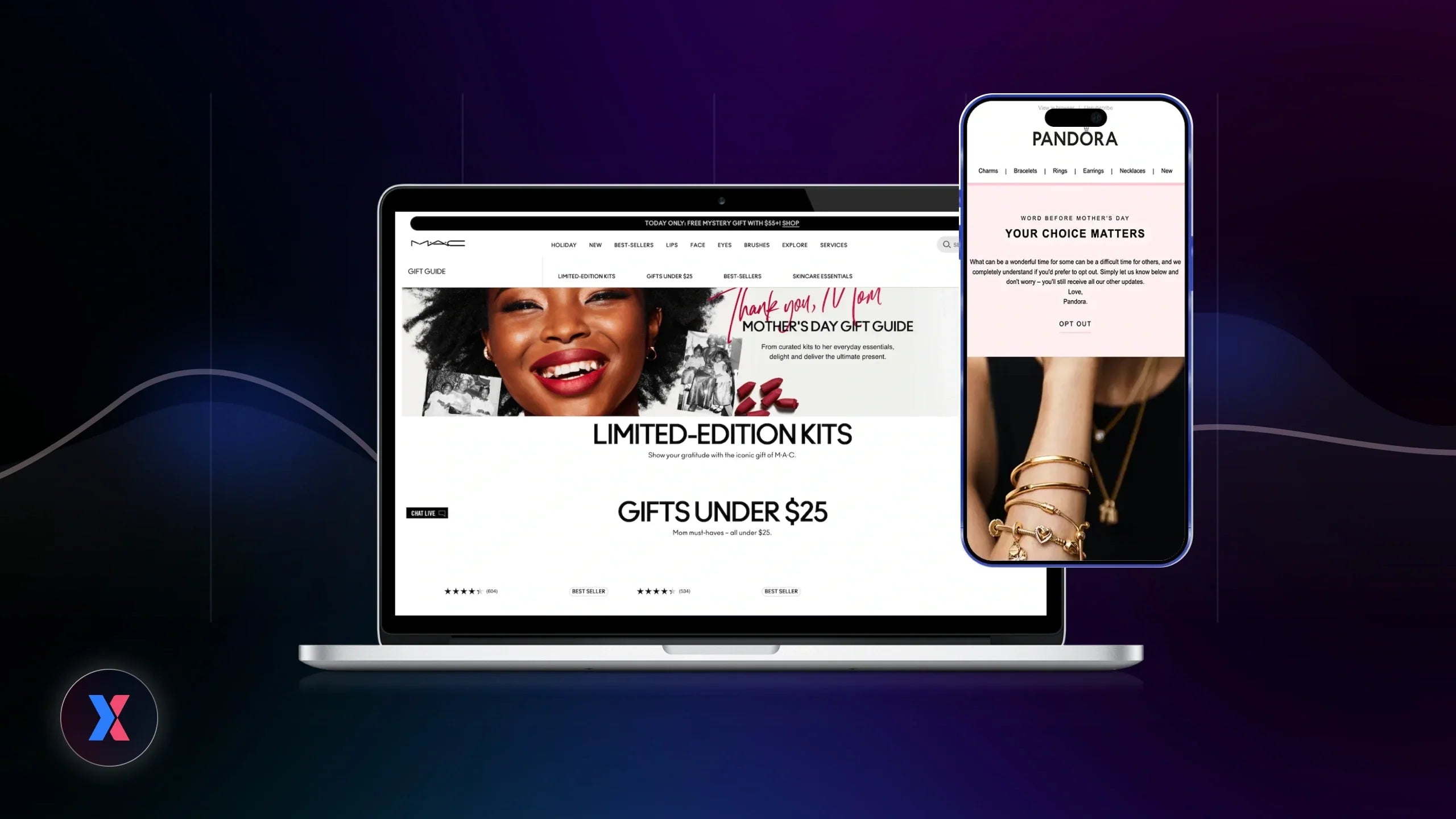
Mother’s Day traffic is easy to get, but what's about the conversions? Not so much.
Every year, Shopify stores pour budget into ads, influencers, and email blasts, only to send that traffic to landing pages that don’t convert. Generic messaging, weak gift positioning, and friction-heavy layouts quietly kill revenue while everything looks like it’s working.
Here’s the uncomfortable truth: during high-intent seasons like Mother’s Day, small UX and messaging gaps don’t just hurt performance. They compound fast.
That’s exactly why Mother’s Day landing page A/B testing isn’t optional. It’s the difference between guessing what works and systematically capturing demand at its peak.
Today, let’s break down what actually drives conversions, what you should be testing right now, and how to turn quick seasonal experiments into repeatable revenue wins.

Why A/B Testing Matters for Mother’s Day Landing Pages
Mother’s Day campaigns don’t behave like your always-on traffic. They’re compressed, emotional, and brutally competitive.
During seasonal holidays like Mother's Day, customers are not casually browsing. They’re actively looking for the right gift, often under time pressure. That shift in behavior is exactly why Mother's Day landing page A/B testing becomes a high-leverage move, not just a CRO tactic.
In this context, even small inefficiencies on your landing page get amplified. A slightly unclear headline, a generic “Shop Now” CTA, or a poorly framed offer can quietly drop conversions across thousands of high-intent sessions. And because the campaign window is short, you don’t get multiple chances to fix it.
This is where landing page A/B testing for Mother’s Day creates a real edge.

Instead of relying on assumptions, you can validate what actually resonates, whether it’s emotional messaging, gift-focused positioning, or urgency-driven offers. More importantly, you can do it fast enough to still capitalize on peak traffic.
Most brands assume their problem is traffic quality. In reality, it’s often conversion friction, which could be a generic messaging that doesn’t speak to gifting intent, a weak urgency that fails to create action, or cluttered layouts that slow decision-making. They are silent killers of your Mother’s Day performance.
By running a A/B test on your Mother’s Day landing page, you isolate these bottlenecks and turn them into measurable wins. Instead of improving a single campaign, you’re building a feedback loop that informs every future seasonal push.
Learn more: Holiday A/B Testing Ideas: Optimize Your Mother’s Day Campaign for Conversions Boosting
7 High-Impact Mother’s Day Landing Page A/B Testing Ideas
#1. Emotional Messaging vs Discount-First Framing
Why it matters: Mother’s Day is not a transactional moment, it’s an emotional one. If your landing page leads with discounts, you’re positioning the purchase as optional. If it leads with meaning, you’re positioning it as necessary.
A strong example of this approach can be seen in Apple Mother’s Day landing page.
Instead of opening with promotions, Apple frames the campaign around connection, “Celebrate whoever you call Mom”, before introducing products.

Source: Apple
The landing experience pulls users into a mindset of appreciation first, purchase second.
Apple prioritizes emotional storytelling in the hero section rather than discount-driven messaging, effectively testing intent framing at the very first touchpoint.
Takeaways for your store:
-
Test emotional headline vs discount headline in the hero section
-
Test gift-oriented messaging vs product-oriented messaging
-
Test storytelling subheading vs feature-driven copy
-
Test “gift for mom” framing vs “buy product” framing
#2. Guided Gift Discovery vs Direct Product Push
Why it matters: Most Mother’s Day shoppers don’t know what to buy, they’re solving a problem, not searching for a product. If your landing page assumes product intent, you’re forcing users to figure things out themselves.
We'll break down a real example from Cadbury to see how this works in practice.
Their campaign introduced a “build-your-own gift hamper” experience, turning the landing page into a guided journey rather than a static storefront.

Source: Cadbury
Cadbury effectively tests experience structure, whether users convert better when guided through gift creation versus being presented with pre-selected products.
Takeaways for your store:
-
Test gift guide layout vs single-product landing page
-
Test curated collections (by persona) vs generic catalog
-
Test interactive bundle builder vs static bundles
-
Test “shop by recipient” vs “shop by product type”
#3. Personalization Layer vs Static Experience
Why it matters: Gifting is personal by nature, but most landing pages are generic. That gap reduces relevance, especially for first-time visitors who need contextual cues.
Let's back to the Mother's Day campaign from Apple.
Their engraving option allows users to personalize products directly on the landing journey, making the purchase feel more intentional and unique.

Source: Apple
Apple tests perceived personalization value, whether adding customization options increases emotional attachment and conversion.
Takeaways for your store:
-
Test adding personalization options (engraving, notes, customization)
-
Test persona-based sections (e.g. “For New Moms”, “For Grandma”)
-
Test dynamic product recommendations vs static listings
-
Test personalized messaging vs generic campaign copy
#4. Urgency Placement vs Passive Visibility
Why it matters: Urgency is everywhere during Mother’s Day, but most brands treat it as decoration instead of a decision trigger. Placement determines whether urgency drives action or gets ignored.
Here’s how Showcase applies this strategy in a real-world Mother’s Day landing page.
Their landing pages layer urgency across the experience, countdown timers, limited-time offers, and delivery deadlines, rather than isolating it in one place.

Source: Showcase
Showcase tests urgency distribution and placement, ensuring users encounter time pressure at multiple decision points.
Takeaways for your store:
-
Test countdown timer above the fold vs near CTA
-
Test shipping deadline near add-to-cart vs header banner
-
Test single urgency element vs multiple layered urgency cues
-
Test static urgency text vs dynamic countdown
#5. Offer Structure: Discount vs Bundle Logic
Why it matters: While discounts reduce price, bundles increase perceived value. During gifting seasons, value perception often drives higher spend than pure savings.
Take Showcase as a quick example.
Instead of running traditional discounts, Showcase push bundle offers like “Buy 3 Get 1 Free,” encouraging customers to buy more while feeling rewarded.

Source: Showcase
Showcase tests offer framing psychology, whether users respond better to value expansion (bundles) than price reduction.
Takeaways for your store:
-
Test % discount vs bundle offer
-
Test “Buy more, save more” vs flat discount
-
Test free gift with purchase vs price reduction
-
Test bundle-focused landing page vs single-item promotion
#6. Visual Storytelling vs Product-Only Imagery
Why it matters: A product image explains what you’re buying. A lifestyle image explains why it matters. For Mother’s Day, that distinction directly impacts conversion.
Let's go through a real-world example from Pandora.
Their campaigns emphasize emotional storytelling, such as moments between loved ones, rather than focusing purely on product visuals.

Source: Pandora
Pandora tests emotional resonance through visuals, prioritizing storytelling over product clarity.
Takeaways for your store:
-
Test lifestyle imagery vs product-only images
-
Test emotional storytelling visuals vs clean ecommerce layout
-
Test user-generated content vs studio images
-
Test hero banner with people vs product-focused hero
#7. Simplified Flow vs Full Navigation Experience
Why it matters: Mother’s Day shoppers are goal-oriented and often time-constrained. Too many choices increase friction instead of improving exploration.
To understand this better, look at how Coach structures their Mother’s Day campaign.
Many successful campaigns use dedicated landing pages with reduced navigation, guiding users through a simplified path to purchase.

Source: Coach
These stores test decision flow optimization, whether reducing navigation improves conversion by shortening the journey.
Takeaways for your store:
-
Test full navigation vs simplified landing page
-
Test guided flow (step-by-step gift selection) vs free browsing
-
Test limited product selection vs full catalog
-
Test single CTA path vs multiple competing actions
Key takeaways: Every one of these examples highlights the same underlying principle: High-performing brands don’t just design pages, they test decision psychology.
Your advantage doesn’t come from copying these ideas. It comes from turning them into structured experiments through Mother’s day landing page A/B testing.
That’s how seasonal campaigns stop being one-time spikes and start becoming repeatable growth systems.
From Ideas to Experiments: What Most Brands Get Wrong
You know that coming up with ideas is easy, but running an effective test for Mother’s Day landing is not.
Every year, brands launch seasonal campaigns packed with “good ideas”: new banners, fresh visuals, updated CTAs. However, when results come in, nothing is conclusive: no clear winner, no scalable insight, just noise.
Lack of creativity is not your problem, but the structure is.
Most brands treat A/B testing like design iteration instead of controlled experimentation. They change multiple elements at once, test vague concepts, and hope something moves. That approach doesn’t generate insight, it just creates confusion.
A real experiment starts with a clear hypothesis instead of a task or a design change.
That means defining three things upfront: (1) who you’re targeting, (2) what exactly you’re changing, and (3) what outcome you expect to impact. Without those, you’re not testing, you’re just guessing.
You’ll see this mistake everywhere.
A weak approach sounds like:“Let’s test a new Mother’s Day banner.”
It feels actionable, but it’s actually untestable. There’s no clarity on what changed or why it should perform better.
Now, let's change to a strong hypothesis forces precision:
| “For first-time visitors, replacing discount-focused hero messaging with emotional storytelling will increase conversion rate.” |
Now you have direction. You know the audience, the variable, and the expected outcome. More importantly, when the test ends, you’ll know why it worked, or why it didn’t.
This is the shift most brands fail to make. They focus on what to change, instead of what to learn.
And during short seasonal windows like Mother’s Day, that mistake is expensive. You don’t have time to run endless experiments. Every test needs to generate insight you can reuse, across campaigns, across pages, across the entire funnel.
Learn more: 8+ High-impact A/B Testing Ideas for E-commerce Funnel in 2026
How to Run Mother’s Day Landing Page A/B Tests on Shopify
This is where most teams break.
Not because they don’t have ideas, but because they can’t execute fast enough. By the time a test is set up, reviewed, and deployed, half the Mother’s Day campaign window is already gone.
Shopify is not built for experimentation by default. So when brands try to run Mother’s Day landing page A/B testing, they run into the same bottlenecks: theme conflicts, performance drops, dependency on developers, and worst case, breaking the live storefront during peak traffic.
That’s exactly why testing tools for Shopify become critical.
With a Shopify-native testing tool like GemX: CRO & A/B Testing, you’re not hacking A/B testing into your store, you’re building it directly into your workflow.
Step 1: Turn Your Idea Into a Testable Variant
Instead of redesigning pages from scratch, GemX allows you to duplicate your existing landing page and turn it into a test variant instantly.
This is where speed compounds.
You can take a high-impact idea, like switching from discount-led messaging to emotional storytelling, and implement it directly on a duplicated version of your page, without touching your live theme.
GemX ensures there are no dev tickets and no risk to your original layout.
Step 2: Control Traffic Split Based on Risk Level
Not every test should be 50/50.
For high-traffic, high-stakes campaigns like Mother’s Day, you may want to start with a lower-risk split (e.g. 70/30) and scale once early signals look promising.

GemX gives you full control over traffic allocation, so you can:
-
Minimize revenue risk during early testing
-
Gradually shift traffic toward winning variants
-
Run multiple experiments across different audience segments
This is especially important when you’re working within a short seasonal window.
Step 3: Launch Without Breaking Your Store
One of the highest hidden costs of A/B testing on Shopify is technical instability.
Imagine that the scripts conflict, the page speed drops, and the checkout breaks, which would be a nightmare with any Shopify merchants
GemX avoids this entirely by operating as a Shopify-native layer, meaning your experiments run cleanly without interfering with your theme architecture or checkout flow.
Using GemX, you don't inject external scripts, instead, you run controlled experiments inside your existing ecosystem. This is difference is huge during peak campaign periods.
Step 4: Measure What Actually Matters – Revenue
Most testing tools stop at clicks or conversion rate, but during Mother’s Day, that’s not enough.
You need to clarify:
-
Which variant drives more revenue
-
Which increases average order value
-
Which performs better across the full funnel

GemX helps you track performance at the revenue level, not just surface metrics. That allows you to make decisions based on actual business impact, not vanity metrics.
Why This Matters for Mother’s Day Campaigns
Seasonal campaigns compress everything, from traffic, decision-making, and revenue opportunity, into a very short timeframe.
That means:
-
You don’t have time for slow iterations
-
You can’t afford technical risk
-
Every test needs to produce actionable insight fast
With GemX, Mother’s Day landing page A/B testing becomes operational instead of theoretical. You can go from idea → experiment → insight in days, not weeks. And in a campaign where timing is everything, that’s the difference between testing… and actually winning.
Best Tips to Turn Your Seasonal Traffic Into Repeatable Growth
Mother’s Day shouldn’t be treated as a one-time revenue spike. If you’re only optimizing for short-term conversions, you’re leaving long-term growth on the table.
The real leverage of Mother’s Day landing page A/B testing is not just winning this campaign. It’s building a system that compounds across every campaign after it.
Here’s where most brands miss:
| They run tests, pick a winner, then move on.
No documentation, no pattern recognition, and no reuse. |
So when the next campaign comes, Father’s Day, Black Friday, Holiday, they start from zero again.
Winning brands don’t do that. They treat every test as an input into a larger growth engine.
From One-Off Tests to a Learning System
When you run structured experiments with GemX, you’re not just validating what works, you’re building a library of proven conversion patterns.
Over time, you start to see repeatable insights:
-
Emotional messaging consistently outperforms discount-led messaging for cold traffic
-
Bundle offers increase AOV during gifting seasons
-
Urgency near CTA drives higher conversion than top-banner urgency
These are not “Mother’s Day insights”, they’re customer behavior insights, and that’s what scales.
Apply Learnings Across Campaigns
Once you have validated winners, the next step is distribution.
A high-performing variation shouldn’t stay locked in one landing page. You can quickly reuse and adapt winning elements across:
-
Future seasonal campaigns (Father’s Day, Valentine’s Day, BFCM)
-
Always-on landing pages
-
Different audience segments
For example, if emotional hero messaging wins during Mother’s Day, you can deploy that same framework, adjusted for context, into Father’s Day campaigns without re-testing from scratch.
Learn more: High-Impact Ecommerce CRO Experiments You Should Run First
Scale From Page-Level to Funnel-Level Testing
Most brands stop at landing pages, but real growth happens when you connect experiments across the entire funnel.
Once you identify a winning element on your Mother’s Day landing page, you can extend that insight into:
-
Product pages (same messaging angle)
-
Cart experience (urgency + offer structure)
-
Upsell flows (bundle logic)
This transition becomes operational. You’re not just testing isolated pages, you’re iterating on the entire conversion journey.
The Compounding Effect
This is where things start to snowball. Instead of running isolated tests for every campaign, you’re stacking validated improvements:
-
Better messaging → higher engagement
-
Better structure → lower friction
-
Better offers → higher AOV
Each campaign builds on the last. So over time, your baseline performance improves, even before you start testing.
Conclusion
Mother’s Day is a compressed growth window where every decision compounds—messaging, layout, offer, and timing all directly impact revenue.
The brands that outperform aren’t relying on creative instincts alone. They validate what resonates, double down on what works, and carry those insights into future campaigns. That’s how mother’s day landing page A/B testing evolves from a tactic into a scalable system.
To get there, execution speed and reliability matter. You need to launch variations quickly, control risk, and measure results based on actual revenue—not just clicks or surface metrics.
That’s exactly what GemX is built for.
Install GemX to create, run, and scale high-impact A/B tests on your Shopify landing pages: fast, stable, and fully aligned with your store.
FAQs


