


- What Makes Mother’s Day Campaigns Unique
- A/B Testing Ideas for Mother’s Day Messaging
- A/B Test Your Mother’s Day Offers
- Product Page A/B Testing for Mother’s Day Shoppers
- Don’t Stop at One Page: Try to Test the Entire Holiday Funnel
- Best Tips to Run A/B Tests During Short Holiday Windows
- How Shopify Merchants Run High-Impact Holiday Tests With GemX
- Conclusion
- FAQs about A/B Testing Ideas for Mother’s Day
Mother’s Day isn’t just another seasonal campaign. It’s a high-emotion, high-competition revenue window where traffic spikes, ad costs rise, and every small decision impacts your bottom line. Many Shopify brands focus on creative ideas and promotional banners, but very few approach it with a structured testing mindset.
That’s where holiday A/B testing ideas become a competitive advantage.
Instead of guessing which headline feels more heartfelt, which discount converts better, or whether a dedicated landing page outperforms your homepage, you can test those variables with real data. The difference between a “good” Mother’s Day campaign and a high-performing one often comes down to measurable optimization.
In this guide, let’s break down practical A/B testing ideas for Mother’s Day and show you how to turn seasonal traffic into predictable, conversion-driven revenue.

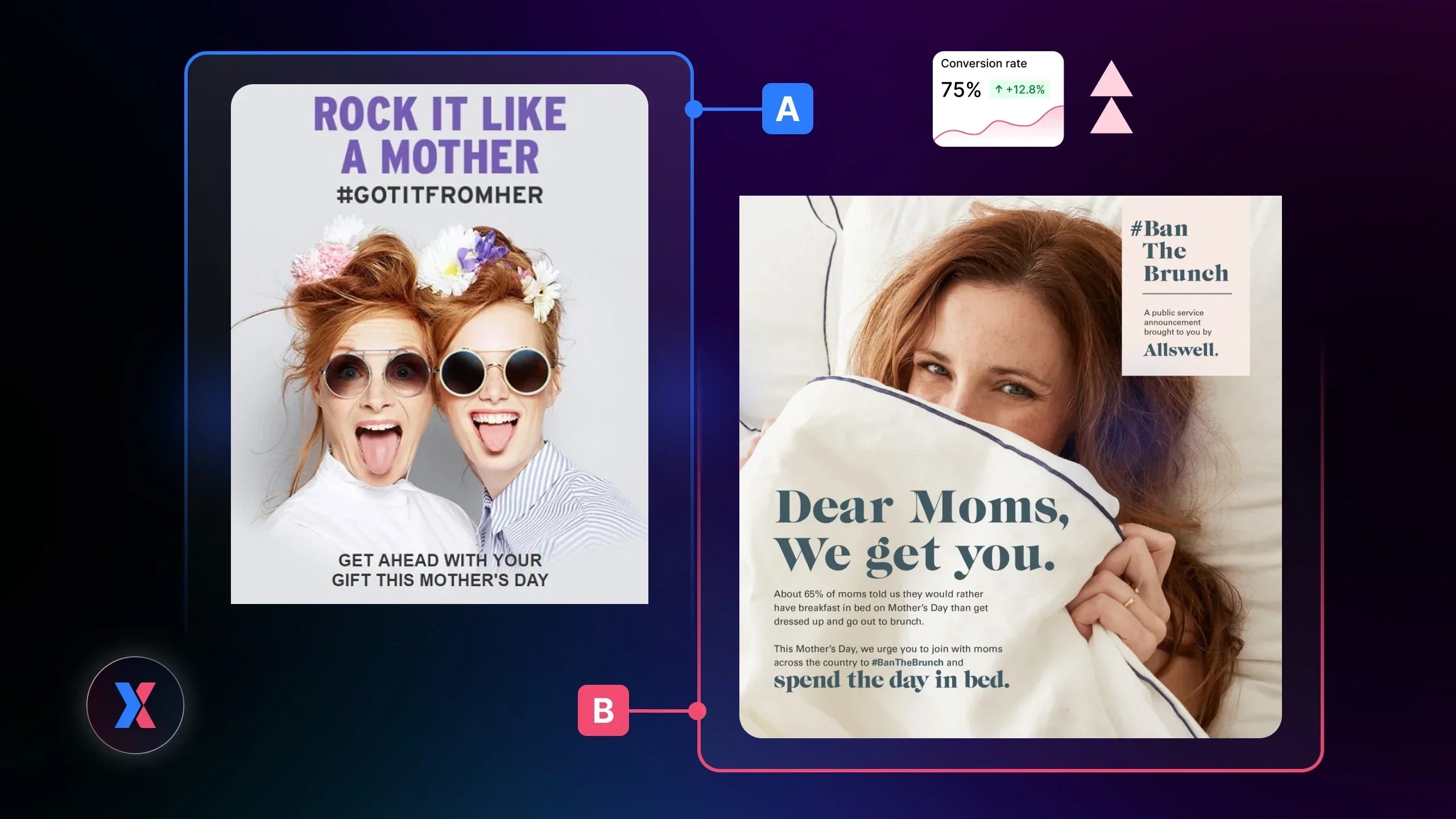
What Makes Mother’s Day Campaigns Unique
During Mother’s Day, customer behavior and traffic patterns shift in measurable ways. If you recognize these changes soon, you can prioritize the right experiments and avoid scaling decisions based purely on instinct.
Emotion Shapes Purchase Decisions More Than Usual
Mother’s Day purchases are emotionally driven. Customers are not only evaluating price or features. They are expressing appreciation, love, or even urgency to avoid “forgetting.”
That emotional layer affects how users respond to headlines, imagery, and calls to action. A gratitude-focused message may perform very differently from an urgency-driven one. Instead of relying on brand preference, testing emotional framing allows you to measure which message actually drives higher click-through and conversion rates.
If you’re exploring A/B testing ideas for Mother’s Day, messaging should be one of the first variables to validate.
A Fixed Deadline Increases Urgency Sensitivity
Mother’s Day comes with a hard cutoff. As delivery deadlines approach, urgency becomes a stronger conversion lever.
Elements such as countdown timers, shipping cut-off reminders, and express delivery badges can influence checkout completion, but their effectiveness varies by audience and traffic source. Testing urgency-based messaging against appreciation-based copy helps you understand what truly reduces hesitation.
During seasonal spikes, small adjustments in how urgency is presented can translate directly into revenue gains.
Gift-Driven Behavior Changes Offer Sensitivity
Because customers are shopping for someone else, perceived value often matters more than raw discounts. This opens opportunities to test bundles, gifts, or threshold-based promotions instead of default percentage offers.
Each structure affects margin and revenue per visitor differently. Without structured testing, it’s difficult to know which promotion maximizes profit during peak traffic.
Holiday campaigns are a practical environment to validate these offer experiments with real data.
Learn more: How to Use A/B Test Offer to Increase Your Profit Without More Traffic
Traffic Spikes Alter Funnel Behavior
Seasonal campaigns typically attract more new visitors, often from paid channels. This shift can change device mix, drop-off patterns, and trust sensitivity across your funnel.

What converts during steady traffic may not perform the same during Mother’s Day. Testing landing page layouts, product page hierarchy, or review placement helps you identify friction that only appears under high-traffic conditions.
Short Windows Reduce Margin for Error
Unlike evergreen campaigns, Mother’s Day provides limited time to iterate. Declaring winners too early or misreading data can lead to scaling the wrong variant during your most valuable traffic period.
Holiday experiments require clear hypotheses, focused variables, and disciplined interpretation. When executed correctly, the insights extend beyond one campaign and strengthen your long-term experimentation strategy.
A/B Testing Ideas for Mother’s Day Messaging
Messaging is often the most visible part of a seasonal campaign, and the most debated internally. During Mother’s Day, however, copy decisions carry more weight than usual. Emotional context, urgency, and gift intent all shape how visitors interpret your headlines and calls to action.
If you’re looking for practical A/B testing ideas for Mother’s Day, start with messaging variables that directly influence click-through rate, engagement depth, and add-to-cart behavior. These tests are simple to implement, yet powerful during high-traffic holiday periods.
#1. Gratitude-Focused vs Nostalgia-Focused Headlines
Mother’s Day messaging typically leans into appreciation. But not all emotional angles perform equally.
One headline may highlight gratitude and celebration, while another evokes nostalgia or memory. Both feel aligned with the holiday, yet they can generate very different engagement patterns depending on your audience.

Testing headline framing helps you answer questions such as:
-
Does emotionally reflective copy increase time on page?
-
Does celebratory language drive higher add-to-cart rates?
-
Which angle resonates better with cold traffic from paid ads?
Rather than defaulting to brand preference, structured headline experiments allow you to validate which emotional direction actually supports conversion.
Learn more: 8+ A/B Testing Ideas for E-commerce: From Hypotheses to High-Impact Results
#2. Urgency-Driven Copy vs Appreciation-Driven Copy
As delivery deadlines approach, urgency becomes a stronger psychological trigger. However, excessive urgency can also feel transactional in a gift-focused context.
For example, delivery cut-off messaging may increase checkout completion in the final days before Mother’s Day, while appreciation-focused copy may perform better earlier in the campaign window.
Testing these two approaches allows you to identify:
-
When urgency meaningfully reduces hesitation
-
Whether deadline reminders improve conversion rate
-
How tone affects trust and perceived authenticity
Holiday campaigns are dynamic. Messaging that works one week before Mother’s Day may not perform the same way three days before shipping closes. Testing these shifts provides actionable data rather than assumptions.
#3. Personalized Gift Messaging vs Generic Promotional Copy
Gift-driven campaigns offer a natural opportunity to test personalization cues.
Copy that explicitly references “your mom” or “the perfect gift for her” may feel more tailored and emotionally relevant than generic promotional language. However, personalization can also narrow perceived product scope if not positioned carefully.
By running this type of A/B test, you can measure:
-
Whether personalization improves click-through rate
-
If it increases the add-to-cart for first-time visitors
-
How it affect the bounce rate on seasonal landing pages

These messaging experiments are especially valuable when combined with broader holiday A/B testing ideas, such as landing page or funnel-level optimization.
Key takeaway: During high-competition periods like Mother’s Day, messaging is not just a creative expression. It is a measurable conversion variable. Structured testing ensures that your seasonal copy supports revenue goals.
A/B Test Your Mother’s Day Offers
During seasonal campaigns, many brands focus heavily on ad creatives while leaving the core offer untouched. However, your promotion structure often has a greater impact on profitability than your ad copy. If you are serious about implementing effective holiday A/B testing ideas, your Mother’s Day offer should be treated as a primary conversion lever.
Offer experiments influence not only conversion rate, but also average order value, revenue per visitor, and margin protection. Instead of defaulting to what worked last year, structured testing helps you identify which promotion actually maximizes performance during this high-traffic window.
#4. Bundle vs Percentage Discount
Gift-driven holidays naturally lend themselves to curated bundles. A “Mother’s Day Gift Set – Save $25” communicates perceived value differently than a blanket “20% Off Sitewide” promotion.
Bundles can:
-
Increase average order value
-
Simplify decision-making for gift buyers
-
Protect the margin more effectively
Percentage discounts, on the other hand, may attract broader price-sensitive traffic but reduce per-order profitability.

Source: WowRevenue
Testing these two structures allows you to measure:
-
Which model drives higher revenue per visitor
-
Whether curated gifting increases checkout completion
-
How the promotion type affects margin during peak demand
Learn more: From Clicks to Purchases: A Smarter Way to Test CTAs & Offers on Shopify
#5. Free Shipping vs Free Gift
Free shipping is often considered a default incentive. However, during Mother’s Day, a gift can feel more emotionally aligned with the occasion.
The difference is psychological. Free shipping removes friction. A free gift adds perceived value.
Running this test helps answer:
-
Which incentive increases the add-to-cart rate
-
Whether customers respond more to convenience or added value
-
How each option impacts overall profitability
Because Mother’s Day traffic is often gift-motivated rather than purely price-driven, this comparison can reveal insights that extend beyond the holiday itself.
#6. Countdown Timer vs Static Promotional Banner
As the holiday approaches, urgency becomes a measurable variable. A countdown timer communicates scarcity and time pressure, while a static banner maintains a calmer brand tone.

Testing these formats helps determine:
-
Whether visible urgency increases checkout completion
-
If countdown timers reduce hesitation near shipping cut-offs
-
How urgency messaging affects trust and perceived pressure
This type of experiment is particularly important in the final days leading up to Mother’s Day, when decision windows shrink and abandonment risk increases.
Pro tip: During Mother’s Day, your offer is not just a promotional detail. It defines how customers perceive value, urgency, and relevance. Treating it as a testable variable ensures that your seasonal campaign is optimized for revenue, not just visibility.
Product Page A/B Testing for Mother’s Day Shoppers
When seasonal traffic lands on your store, the product page becomes the final decision layer. During Mother’s Day, visitors are often buying under time pressure and emotional intent. That combination increases sensitivity to reassurance, clarity, and visual hierarchy.
If you are building a structured list of holiday A/B testing ideas, product page experiments should be prioritized alongside messaging and offer tests. Even small layout adjustments can influence add-to-cart rate and checkout progression during high-competition periods.
#7. Add “Perfect for Mom” Badges Above the Fold
Seasonal badges can help customers immediately understand relevance. A subtle “Perfect for Mom” or “Mother’s Day Pick” label placed near the product title may reduce cognitive load for gift buyers who are browsing quickly.
However, badge placement matters. Above-the-fold positioning increases visibility but can also clutter the hero section if overused. Testing with and without a seasonal badge, or comparing placement near the product image versus the title, allows you to measure its real impact on:
-
Add-to-cart rate
-
Scroll depth
-
Engagement time
This type of test is simple to implement yet highly aligned with A/B testing ideas for Mother’s Day, especially for brands with broad catalogs.
#8. Move Reviews Higher on the Page
Gift buyers often seek reassurance before purchasing. During Mother’s Day, trust signals can carry more weight because customers want confidence in product quality and delivery reliability.
Many stores place reviews lower on the page, below product descriptions or image galleries. Testing a version where star ratings and key testimonials appear closer to the top can help determine whether earlier social proof reduces hesitation.

Key metrics to monitor include:
-
Add-to-cart rate
-
Bounce rate
-
Checkout initiation
This experiment is particularly valuable when combined with broader Shopify conversion rate optimization efforts, as it addresses trust friction rather than pricing.
#9. Gift Guide Layout vs Standard Collection Grid
Seasonal traffic may respond differently to curated experiences. Instead of sending Mother’s Day shoppers to a standard collection page, you can test a dedicated gift guide layout that groups products by price range, personality type, or use case.
For example, a structured gift guide may:
-
Shorten browsing time
-
Increase average order value through curated bundles
-
Reduce drop-off among first-time visitors

A Mother's Day gift guide from IKEA.
Comparing a dedicated Mother’s Day landing experience with your default grid layout allows you to measure which structure drives higher revenue per visitor.
This test links product page experimentation to broader funnel strategy, especially when seasonal traffic comes from paid campaigns.
Key takeaway: Product page optimization during Mother’s Day is not about redesigning your store. It is about validating how seasonal context changes buyer behavior. Structured page-level experiments ensure that your product experience supports conversion goals during one of the most time-sensitive campaigns of the year.\
Don’t Stop at One Page: Try to Test the Entire Holiday Funnel
Most brands approach Mother’s Day optimization at the page level. They refine headlines, adjust banners, and tweak product descriptions. While those changes matter, seasonal performance is rarely determined by a single page.
Mother’s Day traffic often enters your store through paid ads, email campaigns, or social promotions. That means visitors move across multiple touchpoints before purchasing. If you only test isolated elements, you risk optimizing locally while underperforming across the full journey.
Expanding your holiday A/B testing ideas to the entire funnel allows you to identify where revenue is truly won or lost.
Why Funnel-Level Testing Matters During Holidays
Mother’s Day compresses traffic into a short window. That makes every friction point across your funnel more expensive. Page-level improvements may increase click-through rate, but if checkout friction remains unresolved, overall revenue performance will still suffer.
Running structured experiments across multiple pages requires a testing framework that can split traffic consistently, measure behavior at each stage, and compare revenue outcomes between complete journeys.

Source: Aillum
For Shopify merchants, this is where funnel-level experimentation becomes practical rather than theoretical. Tools designed for template and multi-page testing enable you to validate seasonal journeys without restructuring your entire store or introducing development risk.
When your optimization approach covers the full path from landing page to checkout, Mother’s Day stops being a high-pressure gamble and becomes a controlled, measurable growth opportunity.
#10. Dedicated Landing Page vs Homepage Traffic
Seasonal traffic behaves differently from evergreen visitors. Cold users arriving from paid campaigns may convert better on a focused Mother’s Day landing page than on your general homepage.
A dedicated landing page can:
-
Reduce distractions
-
Highlight curated gift selections
-
Reinforce urgency and shipping guarantees
-
Align closely with ad messaging

A dedicated landing page for Mother's Day from Kay Jewelers brand. Source: Convertflow
Testing traffic between a seasonal landing page and your homepage helps you measure which entry experience drives higher add-to-cart and checkout rates. This type of experiment is especially important when ad costs increase during holiday periods, and efficiency becomes critical.
Learn more: How to Test Landing Pages for Paid Traffic in 2026
#11. Gift Quiz or Gift Finder Flow vs Static Browsing
Some brands introduce a gift quiz or guided selection tool during Mother’s Day to help shoppers find the “perfect gift.” Others rely on traditional browsing through collections.
A multi-step gift finder can personalize the experience and reduce decision fatigue. However, it also introduces additional steps in the funnel.
Testing a guided flow against standard browsing helps you evaluate:
-
Completion rate through the quiz
-
Impact on average order value
-
Drop-off points between selection and checkout
This type of experiment moves beyond page-level optimization and into structured funnel testing. It measures how the entire path influences revenue, not just individual elements.
#12. Exit-Intent Gift Reminder vs No Recovery Layer
As the holiday approaches, abandonment risk increases. Shoppers may hesitate due to delivery uncertainty or price sensitivity.
An exit-intent reminder that reinforces shipping deadlines or suggests curated gift options can help recover abandoned visitors. However, adding popups indiscriminately may reduce trust or disrupt the experience.
Testing the presence, timing, or messaging of a recovery layer allows you to quantify its true impact on conversion rate during peak days.
Best Tips to Run A/B Tests During Short Holiday Windows
Holiday campaigns like Mother’s Day do not give you the luxury of long experimentation cycles. Traffic spikes quickly, purchase intent shifts rapidly, and shipping deadlines create hard stop dates.
If you want your holiday A/B testing ideas to translate into measurable revenue, execution discipline becomes just as important as the ideas themselves.
Here’s how to approach testing when the window is short and the stakes are high.
Tip 1: Start Before the Peak, Not During It
The biggest mistake brands make is launching experiments at the height of seasonal traffic. By that point, you are already paying premium acquisition costs.
Ideally, begin testing two to three weeks before Mother’s Day.

Early traffic allows you to validate messaging, offers, and page structure before urgency peaks. Once the final shipping window approaches, you should already have data-backed direction rather than assumptions.
This phased approach protects revenue when traffic becomes most expensive.
Tip 2: Focus on One Primary Variable at a Time
Short windows require clarity. Testing multiple major changes in a single experiment makes it difficult to identify what actually influenced performance.
For seasonal campaigns, prioritize high-impact variables such as:
-
Headline framing
-
Offer structure
-
Entry-page layout
By isolating one primary variable per test, you gain interpretable results that can be confidently scaled during the peak period.
Tip 3: Expect Faster Data, But Interpret It Carefully
Traffic spikes can shorten the time required to reach statistical confidence. However, faster data does not automatically mean better data.

During high-traffic periods, conversion rates may fluctuate due to shifting audience mix, device distribution, or urgency effects. That volatility increases the risk of misinterpreting early performance differences.
Monitor not only the conversion rate but also:
-
Revenue per visitor
-
Add-to-cart rate
-
Checkout completion rate
Interpreting results in a broader context reduces the risk of optimizing for vanity metrics.
Tip 4: Avoid Declaring Winners Too Early
When revenue pressure rises, the temptation to stop a test early becomes stronger. However, premature decisions can lock in underperforming variants for the most valuable days of the campaign.
Before scaling a winner, ensure:
-
Statistical confidence meets your predefined threshold
-
Results are consistent across devices
-
Revenue impact aligns with business significance, not just percentage lift
Holiday experiments should move quickly, but not impulsively.
Learn more: 13+ A/B Testing Mistakes That Hurt Your Conversions
Tip 5: Freeze Major Changes Before Final Cut-Off
Three to five days before the final shipping deadline, stability becomes more valuable than iteration. At this stage, conversion behavior is heavily influenced by urgency, and large structural changes may introduce unnecessary risk.
Use the final stretch to scale validated winners rather than launch new experiments. Protecting performance during peak days often matters more than squeezing in one last test.
How Shopify Merchants Run High-Impact Holiday Tests With GemX
Coming up with strong holiday A/B testing ideas is only half the equation. The real challenge during campaigns like Mother’s Day is execution: launching experiments quickly, controlling risk, and measuring revenue impact across the entire journey.
For Shopify merchants, this is where structured experimentation infrastructure becomes critical.
Launch Seasonal Variants Without Touching Your Store Theme
Mother’s Day campaigns often require layout adjustments: seasonal badges, curated gift sections, urgency messaging, or dedicated landing templates.
Instead of editing your live theme directly, GemX allows you to create separate template variants and split traffic safely between them. This approach allows you to test:
-
A Mother’s Day-optimized homepage vs your default homepage
-
A curated gift layout vs standard product templates
-
Seasonal messaging vs evergreen copy
Because variants run in parallel, your base theme remains stable. That means no rushed deployments and no last-minute rollbacks during peak traffic.
Learn more: How Dedicated Landing Page Outperforms General Homepage | GemX Use Case Series
Run Multi-Page Holiday Funnel Tests
Mother’s Day conversion rarely depends on one page. Traffic may land on a seasonal campaign page, move to a product page, then pass through the cart and checkout.
GemX enables Shopify merchants to test full funnel paths, which compare entire journeys rather than isolated elements.

For example:
-
Funnel A (the control): (1) Dedicated Mother’s Day landing → (2) Curated product template → (3) Urgency-enhanced cart
vs
-
Funnel B (the variant): (1) Default homepage → (2) Standard product template → (3) Default cart
This level of experimentation reveals which journey produces higher revenue per visitor, not just higher clicks.
During short seasonal windows, that clarity matters.
Learn more: Shopify Funnel Testing: How to Optimize Your Full Conversion Path
Measure Revenue at the Variant Level
Holiday traffic can be volatile. Conversion rates may fluctuate due to urgency effects, device mix, or audience source. Looking only at surface metrics can be misleading.
With variant-level analytics, Shopify merchants can compare:
-
Conversion rate
-
Add-to-cart rate
-
Revenue per visitor
-
Total revenue impact

This makes it easier to scale a winning Mother’s Day variant confidently, especially when traffic costs are elevated and margin protection is essential.
Move From Idea to Deployment in Days
Seasonal campaigns do not wait for long development cycles. Shopify merchants need the ability to test quickly, learn quickly, and apply winning versions before the final shipping deadline.
Because GemX operates within the Shopify ecosystem, teams can launch high-impact holiday tests without heavy development overhead or risky theme duplication. That agility turns experimentation into a competitive advantage during peak demand periods.
Holiday optimization is not about making more changes. It is about making controlled, measurable changes that protect revenue during high-pressure campaigns.
When Shopify merchants combine strong holiday A/B testing ideas with structured testing tools like GemX, Mother’s Day shifts from a creative gamble to a data-backed growth opportunity.
Conclusion
Mother’s Day campaigns bring emotional urgency, higher traffic costs, and compressed buying windows. In that environment, small decisions around messaging, offers, product layout, and funnel structure can significantly influence revenue. The difference between a “busy” campaign and a high-performing one often comes down to structured experimentation.
By applying focused holiday A/B testing ideas, you move from intuition-driven marketing to measurable optimization. Instead of reacting to traffic spikes, you validate what works before scaling it. Instead of guessing which promotion feels strongest, you quantify which version drives higher revenue per visitor.
Seasonal campaigns are too valuable to leave to assumption.
If you’re running Shopify and want to turn Mother’s Day traffic into predictable growth, it’s time to test with confidence.
Install GemX and start running high-impact holiday experiments without breaking your store.
FAQs about A/B Testing Ideas for Mother’s Day
- Emotional headlines (gratitude vs urgency)
- Offer structure (bundle vs discount)
- Free shipping vs free gift
- Dedicated landing page vs homepage
- Product page trust signals (reviews, delivery guarantees)


